Legitimate Decision Authority
On AI-Based Decision-Making and Human Critical Control in Tactical Environments – a critical analysis of Meaningful Human Control (MHC) and Legitimate Decision Authority (LDA).
Krisztián Dombrádi, Ph.D. · Semmelweis University, Budapest, Institute of Behavioural Sciences, Hungarostudy Research Group · August 2, 2026, Budapest.
Abstract
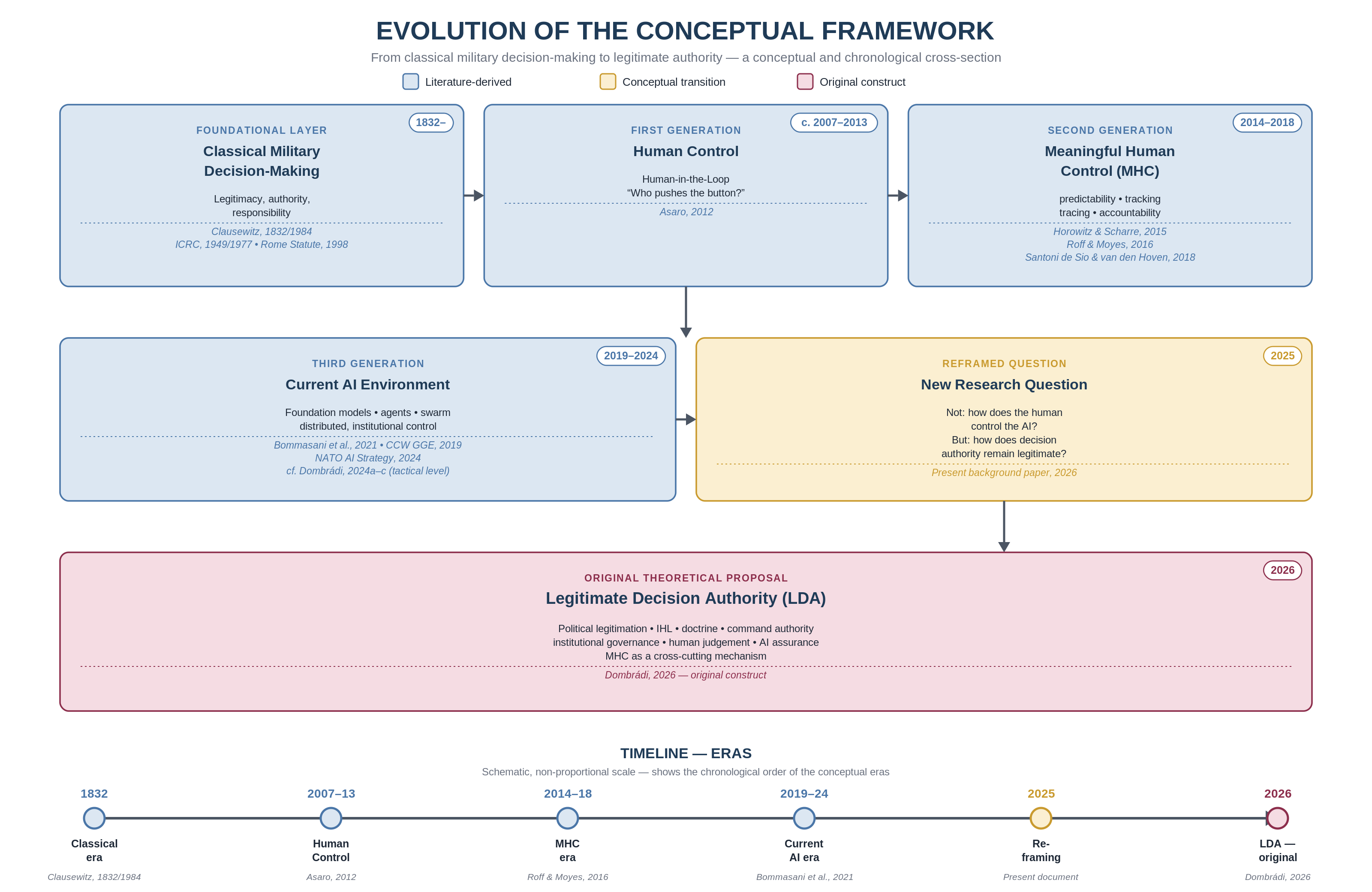
This conceptual background paper examines how AI-supported military decision-making has evolved, and what theoretical response can be given to the fact that Meaningful Human Control (MHC) no longer adequately covers the normative (socio-ethical) challenges of today's distributed, multi-level AI-supported decision architectures. The document provides a review spanning from classical military decision-making (Clausewitz; IHL; command responsibility) through the Human-in-the-Loop paradigm (Asaro, 2012) to the two defining approaches to MHC (Roff & Moyes, 2016; Santoni de Sio & van den Hoven, 2018), supplemented by the characteristics of the current AI environment (foundation models, agent architectures, swarm systems, NATO and CCW frameworks). Building on this, it proposes an original theoretical construct: the concept of Legitimate Decision Authority (LDA), which places the continuity of legitimate decision authority at the centre of the entire AI-supported decision lifecycle – from legitimation, law, and doctrine to institutional governance, human judgement, and AI assurance – within which MHC persists as a cross-cutting mechanism. The document positions the LDA as a construct to be validated, a falsifiable theory-building proposal, and summarises the conceptual genealogy in both a table and a timeline.
Keywords: Meaningful Human Control; Legitimate Decision Authority; military artificial intelligence; AI governance; command responsibility; theory-building.
 Hover over the figure to magnify
1.1. From "Meaningful Human Control" to "Legitimate Decision Authority"
The concept of Legitimate Decision Authority (LDA) is not a simple renaming of MHC, but a theoretical proposal pitched at a higher level of abstraction. Its starting point is the recognition that Meaningful Human Control (MHC), in the autonomous-weapons debate of the 2010s, brought a fundamental normative and political problem into view: the use of armed force must not become a mechanical process from which genuine human deliberation and responsibility disappear. Roff and Moyes developed MHC as a negotiating and operationalisation framework, while Santoni de Sio and van den Hoven worked out the philosophical conditions underpinning moral responsibility (Roff & Moyes, 2016; Santoni de Sio & van den Hoven, 2018).
The LDA proposal is therefore not motivated by a wish to declare MHC flawed or obsolete. It is more accurate to say that MHC has fulfilled its historical mission as a central organising principle: it created the conceptual space in which, instead of the mere fact of human presence, the quality, informedness, accountability relationship, and legal relevance of human participation became open to examination. The present question is how this framework can be situated within an institutional architecture spanning the entire lifecycle of military AI systems.
1.2. Classical Military Decision-Making: Legitimacy, Authority, and Responsibility
The classical model of military decision-making rests on binding the use of force to a political purpose and to legitimate authority. In Clausewitz's view, war is not a self-contained technical process but the continuation of politics by other means; consequently, the meaning and direction of military force derive from the political objective (Clausewitz, 1984). This document does not use this starting point as though Clausewitz offered an AI-governance theory directly, but rather as the classical strategic-theoretical foundation for the relationship between political purpose, military action, and decision authority.
International humanitarian law (IHL) is the body of rules applicable during armed conflict that protects those not taking part in hostilities and restricts the means and methods of warfare (ICRC, 2022). Command responsibility is the institutional bearer of this normative order: Article 87 of Additional Protocol I sets out commanders' duties of prevention and suppression, while Article 28 of the Rome Statute establishes the conditions of criminal responsibility that attach to effective command and control (Additional Protocol I, 1977, art. 87; Rome Statute, 1998, art. 28).
Military doctrine supplies a shared institutional language and framework for action to this end. Allied Joint Publication–01 is NATO's capstone doctrine for joint operations, providing commanders and staffs with a common framework for understanding the use of military force (NATO Standardization Office, 2022). The central question of this classical layer is therefore not which technical element executes a given subtask, but who holds lawful authorization to use force, what norms constrain that authorization, and who can be held accountable for the outcome.
2.1. First Generation: Human Control and the Human-in-the-Loop Paradigm
In the early debate on autonomous systems, the human-in-the-loop model made the direct presence of a human one of the conditions of legitimate operation. The simplified question was: who pushes the button? According to Peter Asaro's analysis, however, the mere insertion of a human into the decision cycle is a necessary but not a sufficient condition. A substantive decision also requires time, training, adequate information, latitude for judgement, and accountability (Asaro, 2012).
This recognition marked the limit of direct human control. An operator's formal approval does not, by itself, resolve the normative problem if the operator does not understand how the system works, has no realistic opportunity to assess the situation, or is merely rubber-stamping an automated recommendation. The next step in the conceptual development therefore called not for more points of human contact, but for qualitatively meaningful human control.
3. Second Generation: Meaningful Human Control
3.1. Roff and Moyes: Operationalisation and the Sociotechnical Context
Roff and Moyes's 2016 briefing paper starts from the premise that neither the use of force entirely without human control, nor the pressing of a "fire" button without cognitive clarity, can be regarded as human control in any substantive sense. They treat MHC as an open policy space in which the necessary threshold and practical content of control can be refined through negotiation among multiple stakeholders (Roff & Moyes, 2016).
In their approach, predictability, transparency, relevant contextual information, and accountability are interrelated conditions. This emphasis treats the weapon not as an isolated object but as part of a sociotechnical system composed of people, procedures, information, organisational roles, and technical components. Human control is thus no longer merely the press of a button, but a quality of decision-making grounded in understanding the system's capabilities and limitations, assessing the context of use, and accepting responsibility for the outcome.
The policy diffusion of the concept of "meaningful human control" was substantially grounded by Horowitz and Scharre's earlier, widely cited primer, on which Roff and Moyes explicitly draw (Horowitz & Scharre, 2015).
3.2. Santoni de Sio and van den Hoven: Tracking, Tracing, and Moral Responsibility
Santoni de Sio and van den Hoven connect MHC to the philosophy of moral responsibility. Their starting point is Fischer and Ravizza's theory of guidance control, according to which the control that grounds responsibility is tied to a decision-making mechanism that can be identified as one's own and that responds appropriately to relevant reasons (Fischer & Ravizza, 1998). The authors translate this approach into actions mediated by autonomous systems. The tracking condition requires that the system's behaviour vary together with the relevant moral reasons of the people involved and with the facts of the operating environment. In formulating this, the authors also draw on Nozick's epistemological notion of "tracking" (Nozick, 1981; Santoni de Sio & van den Hoven, 2018). The tracing condition, in turn, requires that the system's design and operation be traceable to human actors who possess adequate knowledge, normative competence, and an accountability relationship (Santoni de Sio & van den Hoven, 2018).
The philosophical framework also responds to the problem of the responsibility gap: in the case of learning systems, it can happen that neither the manufacturer nor the operator foresaw or fully controlled the specific outcome, while the machine itself is not a proper bearer of moral responsibility (Matthias, 2004). The tracking–tracing model of MHC attempts to address this gap not at a single decision-point, but in the design of the decision-making mechanism and the chain of human accountability.
Heyns's UN report raises a similar concern under the heading of an "accountability vacuum," which highlights the human-rights dimension of the responsibility-gap problem (Heyns, 2013).
4. Third Generation: The Current AI Environment
The two foundational approaches to MHC shared a common historical background: relatively well-delimited autonomous functions, individual attacks, and identifiable points of human intervention stood at the centre of the debate. In today's AI environment, however, sensing, interpretation, prediction, planning, prioritisation, communication, and replanning may be distributed across multiple systems and multiple organisational levels.
Foundation models produce base models adaptable to a wide range of tasks, whose capabilities and risks cannot be confined to a single application (Bommasani et al., 2021). The classical literature on intelligent agents distinguished early on between agent theory, agent architectures, and agent programming (Wooldridge & Jennings, 1995), while swarm robotics examines the collective behaviour that emerges from the decentralised cooperation of simpler units (Brambilla et al., 2013).
The cognitive dimension of tactical-level human–machine cooperation is also explored in Dombrádi's own earlier work. In a 2024 study, he develops a communication-theoretic account of "combined arms warfare" and the concept of closed-order tactical acts, drawing on Niklas Luhmann's operative constructivism and systems theory (Dombrádi, 2024a). Building on this, a further study co-authored with Varga analyses the difference between "knowledge patterns", which form through socialisation and shape human decision-making, and pattern-based, so-called S(AI) systems, concluding that current AI systems are stable and fast but not adaptive relative to the complexity of human knowledge patterns, and that for now they can play more of a preparatory than a substitutive role in tactical decision-making (Varga & Dombrádi, 2024b). A third study, examining the air force's training system, extends the same framework to a comparison of natural and artificial neural networks (Dombrádi, 2024c).
In this environment, the human–machine relationship can rarely be described by a single vertical line. Political leadership, strategic and operational command, legal advisers, intelligence, operators, cloud and edge systems, sensors, multiple AI components, and autonomous functions together form a nested decision ecosystem. NATO's revised 2024 AI strategy itself places particular emphasis on responsibility and accountability, explainability and traceability, reliability, governability, human–machine teaming, and testing, evaluation, verification, and validation capabilities (NATO, 2024).
Control, consequently, is not only an event but a process; not only individual but institutional; not only operational but lifecycle-wide. The CCW's 2019 guiding principles likewise state that human responsibility must be retained, that accountability cannot be transferred to machines, and that the quality of human–machine interaction must be assessed on the basis of the entire weapons system and its operational context (CCW GGE, 2019). The ICRC's position likewise highlights the humanitarian, legal, and ethical risks of losing human control and judgement (ICRC, 2021).
5. Legitimate Human Decision-Making
The logic of this shift can be derived from first principles. The normative purpose of using armed force is not control as such, but the preservation of lawful and legitimate human decision-making. Control is one means to that end. If AI shapes situational understanding and available courses of action across multiple decision stages, multiple organisational levels, and multiple cooperating systems, then the preservation of authority cannot be tied to a single point of approval either.
The new research question can thus be formulated as follows: how can legitimate military decision authority be preserved throughout the entire lifecycle of an AI-supported decision architecture in which the information, models, recommendations, and execution functions feeding into a decision originate, in part, from adaptive, distributed, or autonomous components? This question establishes a broader unit of analysis than technical control alone: it links political legitimation, law, doctrine, command roles, organisational governance, human judgement, and AI assurance.
6. The Original Theoretical Contribution: Legitimate Decision Authority
Legitimate Decision Authority does not mean that every subtask must be carried out by a human, nor is it equivalent to a human being able to override every single machine operation in real time. Here, "authority" refers to the normative origin of the decision, the limits of authorisation, and the continuity of accountability. The system may automate certain sensing, analytic, or execution functions, but the use-of-force architecture as a whole must still derive from legitimate political and legal authorisation.
The layers of the LDA build on one another: political legitimation designates the source of military objectives; IHL and other applicable legal norms define the limits of permissible action; military doctrine and command authority translate these into roles, processes, and decision rights; institutional governance provides for regulation, oversight, auditing, incident management, and organisational learning; human judgement interprets the concrete situation; and AI assurance supplies evidence of the system's reliability, limitations, and auditability. The NIST AI RMF's lifecycle-based risk management and NATO's Responsible Use principles provide important literature-based support for these governance and assurance layers (NIST, 2023; NATO, 2024).
Within this framework, Meaningful Human Control does not disappear. Its function becomes more precise: as a cross-cutting operating mechanism, it ensures that a substantive connection is maintained among legitimation, law, doctrine, decision rights, technical assurance, and autonomous execution. At the level of legitimation it supports the preservation of human political authorisation; at the level of doctrine, the enforcement of legal and operational limits; at the decision level, genuine human deliberation; and at the level of assurance, the requirements of predictability, transparency, tracking, and tracing.
The LDA is therefore not a replacement for MHC but its placement within a larger structure. The ultimate normative goal is not to maximise the number of control points as such, but to ensure that legitimate human authority is not broken anywhere within the decision architecture as a whole. A control point can be formal yet empty; an institutionally designed authority architecture, by contrast, links together multiple technical and organisational mechanisms to ensure that the use of force remains, legally, ethically, and politically, a human decision.
7. Critical Methodological Note and the Need for Validation
From a research-methodological standpoint, the LDA is at present a sensitising concept and a theoretical construct, not a validated paradigm. Its scientific value depends on whether its conceptual boundaries can be clearly distinguished from the existing concepts of human authority, command authority, military necessity, human-centred AI governance, and meaningful human control. The manuscript must therefore present it not as a terminological novelty, but as a theoretical architecture that provides additional explanatory power.
The category of "sensitising concept" was introduced into qualitative social-science methodology by Blumer (1954); the standard definition of "military necessity" is set out by the ICRC Casebook, while the official military definition of "command authority" is contained in the DOD Dictionary of Military and Associated Terms.
The next validation step requires four tasks. First, the elements of the LDA must be systematically cross-checked against the literature on military science, IHL, command responsibility, military ethics, and AI governance. Second, the necessary and sufficient conditions for the LDA must be determined. Third, case-based analysis must examine whether the LDA identifies failures or breaks in accountability that MHC alone does not render visible. Fourth, operationalisable indicators must be developed for the continuity of authority, the clarity of decision rights, assurance evidence, and oversight adaptation.
The model's strongest, and simultaneously most risky, claim is that the normative problem of contemporary military AI cannot be reduced to individual human–machine (AI agent–system cooperation) interactions. If this claim survives literature-based and empirical validation, the LDA may be able to create a shared analytical language across military science, law, organisational theory, and AI assurance. If, however, it does not offer greater explanatory power than the combined application of MHC and existing governance frameworks, it is not warranted as a stand-alone concept.
Annex A: The System of Concepts and New Categories
The table distinguishes the origin in the literature, the role within the present document, and the original theoretical contribution.
| Concept | Defining source | Role in the present framework | Status/source |
|---|---|---|---|
| Political purpose and military force | Clausewitz (1984) | Strategic-theoretical starting point | Literature-derived |
| International humanitarian law | ICRC; 1949 Geneva Conventions and Additional Protocols | Legal limits on the use of force | Literature-derived |
| Command responsibility | Additional Protocol I, art. 87; Rome Statute, art. 28 | Command duty and chain of accountability | Literature-derived |
| Military doctrine | NATO AJP-01 (2022) | Common institutional and operational framework | Literature-derived |
| Human-in-the-Loop | Asaro (2012) | Direct human presence; not sufficient on its own | Literature-derived |
| Meaningful Human Control | Roff & Moyes (2016) | Operationalisation and policy framework | Literature-derived |
| Guidance control | Fischer & Ravizza (1998) | The control that grounds moral responsibility | Literature-derived |
| Tracking | Nozick (1981); Santoni de Sio & van den Hoven (2018) | The system's responsiveness to relevant moral reasons and facts | Literature-derived / adapted |
| Tracing | Santoni de Sio & van den Hoven (2018) | Traceability to appropriate human actors | Literature-derived |
| Responsibility gap | Matthias (2004) | The problem of attributing responsibility in learning systems | Literature-derived |
| AI governance / assurance | NATO (2024); NIST (2023); OECD (2019/2024) | Lifecycle-based governance, risk management, and assurance | Literature-derived synthesis |
| Legitimate Decision Authority | In the present study | The continuity of legitimate authority throughout the entire AI-supported decision architecture | Original construct (Dombrádi, 2026) |
| MHC as a cross-cutting mechanism | Present background paper | The placement of MHC within the LDA architecture | Original construct (Dombrádi, 2026) |
References and Primary Sources
- Asaro, P. M. (2012). On banning autonomous weapon systems: Human rights, automation, and the dehumanization of lethal decision-making. International Review of the Red Cross, 94(886), 687–709. doi.org/10.1017/S1816383112000768
- Blumer, H. (1954). What is wrong with social theory? American Sociological Review, 19(1), 3–10. doi.org/10.2307/2088165
- Bommasani, R. et al. (2021). On the opportunities and risks of foundation models. Stanford Center for Research on Foundation Models.
- Brambilla, M., Ferrante, E., Birattari, M., & Dorigo, M. (2013). Swarm robotics: A review from the swarm engineering perspective. Swarm Intelligence, 7(1), 1–41. doi.org/10.1007/s11721-012-0075-2
- Clausewitz, C. von. (1984). On War (M. Howard & P. Paret, Eds. & Trans.; rev. ed.). Princeton University Press. doi.org/10.2307/j.ctt7svzz
- Convention on Certain Conventional Weapons, Group of Governmental Experts. (2019). Report of the 2019 session (CCW/GGE.1/2019/3), Annex IV: Guiding principles. United Nations Office for Disarmament Affairs.
- Dombrádi, K. (2024a). The communication theory of combined arms warfare. GRIN Verlag. GRIN – Krisztián Dombrádi publications
- Varga, A., & Dombrádi, K. (2024b). The role of AI in decision making for military operations. GRIN Verlag. GRIN – Krisztián Dombrádi publications
- Dombrádi, K. (2024c). Transdisciplinarity: Practical comparison of natural and artificial neural networks. Thoughts on the Air Force renewing training system. GRIN Verlag. GRIN – Krisztián Dombrádi publications
- Fischer, J. M., & Ravizza, M. (1998). Responsibility and Control: A Theory of Moral Responsibility. Cambridge University Press. doi.org/10.1017/CBO9780511814594
- Heyns, C. (2013). Report of the Special Rapporteur on extrajudicial, summary or arbitrary executions (A/HRC/23/47). UN Human Rights Council. ohchr.org
- Horowitz, M. C., & Scharre, P. (2015). Meaningful human control in weapon systems: A primer. Center for a New American Security. cnas.org
- International Committee of the Red Cross. (1977). Protocol Additional to the Geneva Conventions of 12 August 1949 (Protocol I), Article 87.
- International Committee of the Red Cross. (2021). ICRC position on autonomous weapon systems.
- International Committee of the Red Cross. (2022). What is international humanitarian law?
- International Committee of the Red Cross. (n.d.). Military necessity. In How Does Law Protect in War? Online casebook. casebook.icrc.org
- International Criminal Court. (1998). Rome Statute of the International Criminal Court, Article 28.
Additional References
- Joint Chiefs of Staff. (n.d.). DOD Dictionary of Military and Associated Terms. U.S. Department of Defense. jcs.mil
- Matthias, A. (2004). The responsibility gap: Ascribing responsibility for the actions of learning automata. Ethics and Information Technology, 6(3), 175–183. doi.org/10.1007/s10676-004-3422-1
- NATO. (2024). Summary of NATO's revised artificial intelligence (AI) strategy. North Atlantic Treaty Organization.
- NATO Standardization Office. (2022). Allied Joint Publication–01: Allied Joint Doctrine (Edition F, Version 1).
- National Institute of Standards and Technology. (2023). Artificial Intelligence Risk Management Framework (AI RMF 1.0) (NIST AI 100-1). U.S. Department of Commerce. doi.org/10.6028/NIST.AI.100-1
- Nozick, R. (1981). Philosophical Explanations. Belknap Press of Harvard University Press.
- OECD. (2019, amended 2024). Recommendation of the Council on Artificial Intelligence (OECD/LEGAL/0449).
- Roff, H. M., & Moyes, R. (2016). Meaningful human control, artificial intelligence and autonomous weapons: Briefing paper for delegates at the CCW Meeting of Experts on LAWS. Article 36 / Arizona State University.
- Santoni de Sio, F., & van den Hoven, J. (2018). Meaningful human control over autonomous systems: A philosophical account. Frontiers in Robotics and AI, 5, Article 15. doi.org/10.3389/frobt.2018.00015
- Wooldridge, M., & Jennings, N. R. (1995). Intelligent agents: Theory and practice. The Knowledge Engineering Review, 10(2), 115–152. doi.org/10.1017/S0269888900008122