The Deep Transformation of Human Knowledge
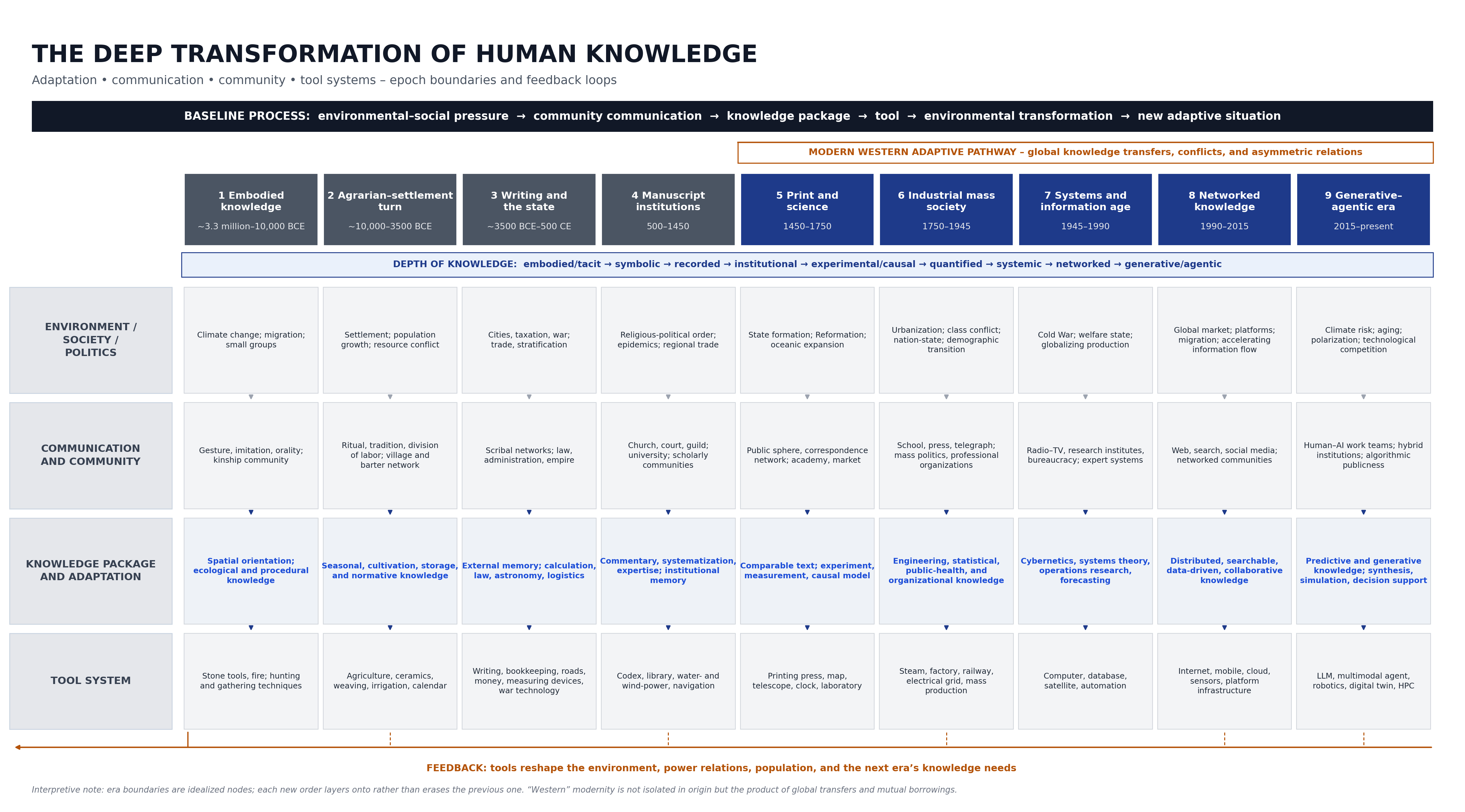
Adaptation, Communication, Community: A Synthetic Flow Model.
 Hover over the figure to magnify
Interpretation of the Diagram
Human knowledge does not simply grow: its carrier, depth, communal structure, and instrumental environment are transformed from one era to the next.
The logic of the diagram. The model does not present a linear history of progress but a set of interlocking adaptive cycles. Environmental, social, political, and demographic change generates problems; the community uses communication to build shared interpretation and a shared order of action; from this a knowledge package and a tool system emerge. Tools, however, are not neutral aids: they reorganize production, power, settlement patterns, population, and the knowledge needs of the next era. The process is therefore a feedback loop, not merely a sequence of technological events.
Adaptation and cumulative culture. A distinctive feature of human adaptation is that a large share of vital solutions spreads through social learning, is preserved within communities, and is modified across generations. Embodied, imitation-transmitted ecological and procedural knowledge made it possible to populate different environments; the agrarian turn then attached seasonal, storage, and normative knowledge packages to settled life. Population size and the degree of contact between groups can determine whether cultural repertoires expand or are partly lost (Henrich & McElreath, 2003; Vaesen, 2012). In this sense, knowledge is not solely an individual property but a communal achievement — a point echoed in Krisztián Dombrádi's account of cumulative "evolutionary knowledge": he describes how a "knowledge community" formed belief, "participated in collective evolution, and was later institutionalized by humanity" (Dombrádi, 2024).
Communication and external memory. Communication is the coordinating infrastructure of adaptation in every era. Orality relies on the memory of the community present; writing detaches information from the speaker's person and moment; manuscript institutions build expert traditions; print creates comparable, mass-produced texts and a wider public. Experiment, measurement, and scientific publication push the depth of knowledge toward causal explanation and verifiability (Stanford Encyclopedia of Philosophy, 2021). The modern Western trajectory becomes distinguishable here, but it does not originate from itself alone: the knowledge flows of the ancient Near East, the Mediterranean world, India, China, Islamic scholarship, Africa, and the Americas are equally part of its preconditions (Smarthistory / British Museum, 2016; Library of Congress, n.d.).
Communal scale-shift and modernity. In the industrial era, the school, the press, statistics, the engineering profession, and nation-state administration create a mass knowledge order. Urbanization, the demographic transition, and the division of labor simultaneously increase specialization and mutual dependence (Ritchie, Samborska, Ortiz-Ospina & Roser, 2025); knowledge is increasingly distributed among institutions, standards, and expert networks. From the mid-20th century, cybernetics, systems theory, and the computer make the language of feedback, modeling, and forecasting dominant. Engelbart's notion of "intellect augmentation," understood as a human–tool system, already articulated the idea that the capacity for complex problem-solving derives from the cooperation of person, method, organization, and technology (Engelbart, 1962).
Networked and agentic knowledge. After the web (CERN, n.d.), external memory became globally searchable, communication instantaneous, and community networked. Generative and agentic AI may mark a new epoch boundary, because it not only stores or transmits but also produces text, models, hypotheses, and action plans. This "knowledge package," however, is a probabilistic synthesis: without source criticism, contextual knowledge, responsible judgment, and social legitimation, it is not equivalent to reliable knowledge. The current task of adaptation is therefore to connect substantive expertise with data and model literacy, problem framing, collaboration, ethical deliberation, and institutional accountability (Stanford HAI, 2026; OECD, 2026). Dombrádi's related caution about accelerating technological change is worth noting here too: he warns that "the individualism and gross irrationalities of modernity are already testing evolutionary knowledge," since "our capacity for evolution and adaptation is no longer a [sufficient] defense in this turbulent environment" (Dombrádi, 2024).
The normative conclusion of the model. The depth of knowledge is measured not by the quantity of information but by the quality of its connections: how far it can uncover causes, integrate different viewpoints, anticipate consequences, and support communally verifiable action. Older forms of knowledge do not disappear; bodily practice, personal trust, orality, and local community remain indispensable even in the digital era. Sustainable modern Western adaptation therefore consists not of ever-increasing automation, but of a balance between technical capacity, communicative openness, communal cohesion, and ecological-demographic responsibility.
Bibliography
The diagram is a synthetic historical model; the epoch boundaries are approximate, and the sources below serve to verify the main claims and data series.
- CERN. (n.d.). The Birth of the Web. CERN. home.cern
- Dombrádi, K. (2024). New Interpretations of Darwin's Evolutionary Theory. GRIN Verlag. grin.com/document/1496193
- Engelbart, D. C. (1962). Augmenting Human Intellect: A Conceptual Framework. SRI Summary Report AFOSR-3223. dougengelbart.org
- Henrich, J., & McElreath, R. (2003). The Evolution of Cultural Evolution. Evolutionary Anthropology, 12(3), 123–135. doi.org/10.1002/evan.10110
- IPCC. (2023). AR6 Synthesis Report: Climate Change 2023. Intergovernmental Panel on Climate Change. ipcc.ch
- Library of Congress. (n.d.). The Gutenberg Bible. Library of Congress Bible Collection. loc.gov
- National Museum of Natural History, Smithsonian Institution. (n.d.). Stone Tools. Human Origins Program. humanorigins.si.edu
- OECD. (2026). AI and Skills: What We Know So Far. OECD Publishing. doi.org/10.1787/f843b352-en
- Ortiz-Ospina, E., & Roser, M. (2024, updated). Literacy. Our World in Data. ourworldindata.org
- Ritchie, H., Samborska, V., Ortiz-Ospina, E., & Roser, M. (2025, updated). Urbanization. Our World in Data. ourworldindata.org
- Smarthistory / British Museum. (2016). Cuneiform, an Introduction. Smarthistory. smarthistory.org
- Smithsonian Institution. (2026). Human Origins Facts. Smithsonian. si.edu
- Stanford Encyclopedia of Philosophy. (2021, with substantive updates). Scientific Method. Stanford University. plato.stanford.edu
- Stanford Institute for Human-Centered AI. (2026). The 2026 AI Index Report. Stanford University. hai.stanford.edu
- UN DESA, Population Division. (2024). World Population Prospects 2024: Summary of Results. United Nations. population.un.org
- UNESCO. (2005). Towards Knowledge Societies: UNESCO World Report. UNESCO Publishing. unesdoc.unesco.org
- Vaesen, K. (2012). Cumulative Cultural Evolution and Demography. PLOS ONE, 7(7), e40989. doi.org/10.1371/journal.pone.0040989